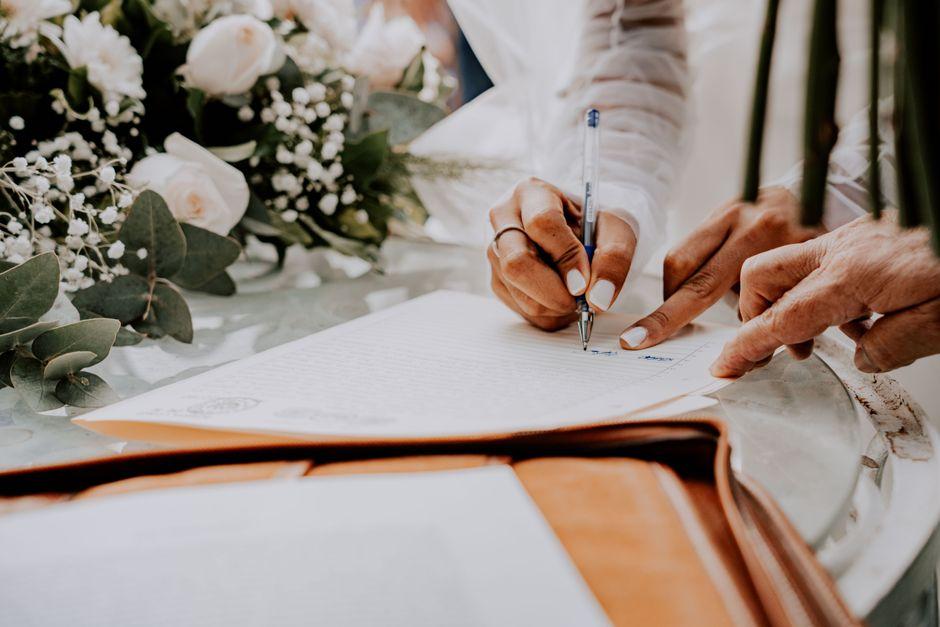
Getting legally married in Virginia comes down to a short list of steps: a license from a circuit court clerk, a ceremony led by someone the Commonwealth authorizes, and a certificate filed after the wedding. This guide summarizes the rules in the Code of Virginia, Title 20, Chapter 2 and what several clerks' offices tell couples. Clerks set some of the practical details themselves, so check with the office where you plan to apply before you go.
The short version
- Who issues it: the clerk or deputy clerk of any circuit court in a Virginia county or city.
- Who applies: both of you, in person, with photo ID. You answer the application questions under oath.
- Age: both of you must be at least 18. There is no longer any exception for younger couples.
- Waiting period, blood test, residency: none, according to the clerks' pages we checked.
- Fee: set locally. Loudoun and Alexandria list $30, Bedford $32.50 and Fauquier $33.
- Validity: 60 days from the day it is issued, for a ceremony held anywhere in Virginia.
- Officiant: an authorized minister, a person a circuit court clerk has authorized (often called a one-day or civil celebrant), or a religious society with no ordained minister.
- After the ceremony: the officiant files the completed certificate with the issuing clerk within five days.
Where to apply
Under § 20-14, every Virginia marriage license is issued by the clerk or a deputy clerk of a circuit court. You can use the clerk in any county or independent city; it does not have to be where you live or where the wedding will be. That makes it easy to apply near home and marry in the Shenandoah Valley or on the Northern Neck.
Plan to go together. Bedford County says both parties must come to the clerk's office and bring photo ID, and Fauquier County notes that as of January 1, 2026 it no longer handles licenses by mail. Under § 20-16 the clerk has you state the application information under oath, and you can list yourselves as spouse, bride or groom. The state's records law, § 32.1-267, also asks for Social Security numbers or a DMV control number on the application, so bring that information with you.
Age, fees and timing
§ 20-48 sets the minimum age to marry at 18, and the 2024 amendment removed the old exceptions. Fees are not one statewide number: Loudoun lists $30 payable by cash or card, Bedford lists $32.50, and Fauquier $33. Ask your clerk which forms of payment it accepts.
The clerks' pages we checked, including Alexandria, list no waiting period, no blood test and no residency requirement, so the license can be used the day you get it. It does not last long, though. § 20-14.1 gives it 60 days from issuance, and Loudoun reminds couples it covers a ceremony only within the Commonwealth. If the 60 days run out, you can apply again under the same rules. A good rule of thumb is to apply about three to six weeks before the wedding: early enough to avoid a last-minute scramble, late enough that the license will not expire.
Who can perform the ceremony
Virginia gives couples three routes. A minister can be authorized under § 20-23 by showing a circuit court proof of ordination and good standing with their religious body. If your officiant is ordained but has never married anyone in Virginia, have them ask a clerk early whether they need that order on file.
Anyone else, such as a friend or relative, can apply to a circuit court clerk for an order under § 20-25 authorizing them to celebrate marriages. The clerk may require a $500 bond, and each office runs this a little differently: Bedford requires the applicant to be at least 18, never convicted of a felony and a Bedford resident, while Alexandria uses a $500 amount that is returned once a certified copy of the license comes back. Start this weeks ahead, not days. Religious societies that have no ordained minister can marry their members under § 20-26, with one person chosen to complete the certificate.
Virginia law does not list a witness requirement for the ceremony, but your officiant, venue or faith tradition may have their own expectations. If you are still looking for someone to lead the ceremony, our Virginia officiant listings are a starting point.
After the ceremony
The clerk gives you two copies of the marriage certificate. Under § 20-16 and § 32.1-267, the officiant completes them and files both with the clerk who issued the license within five days of the ceremony. The clerk keeps one and sends the other to the State Registrar of Vital Records. Ask your officiant how and when they will return it, and ask the clerk how to order certified copies, which you will need for name changes and benefits.
Once the legal side is settled, the rest of the planning can start: see Virginia wedding venue types by region and our guide to vineyard and winery weddings in Virginia.
This is a plain-language summary, not legal advice. Laws and clerks' procedures change, so confirm current requirements with the circuit court clerk before your wedding.